
“But we need sales now!”
I hear some version of this fairly often when discussing positioning, messaging, or thought leadership with B2B clients and prospects.
Why invest in communication when we could hire another salesperson? Wouldn’t the budget be better spent on direct lead generation?
Sometimes, yes. If the main problem is insufficient prospecting capacity, investing in sales resources might be the right decision. But the underlying assumption is often that communication and sales are separate activities. And that communication (or marketing or branding) is just a nice-to-have which we can do “later”.
Having worked with B2B technology companies for many years, I’ve seen how expensive that assumption can be. Why? Because communication is not a nice-to-have, it’s something happening by default – and it can happen strategically or randomly. And because communication has commercial implications.
So, to answer the question in the title plainly:
Strategic communication contributes to B2B sales by building market recognition, helping buyers understand and trust a company’s expertise, equipping sales teams to communicate its value, and reducing inefficiencies throughout the sales process.
Can sales work without good marketing? Sure. For a while at least. But strategic comms can make your prospecting and sales process so much stronger. I’ll explain why, with examples from my work.
1. Market recognition makes sales conversations easier
Market recognition matters because salespeople can have easier conversations. When prospects have already encountered the company’s content, heard its experts speak, or seen it referenced by trusted industry sources, they are more willing to listen and eventually buy.
Familiarity doesn’t guarantee a sale. But it can greatly reduce the amount of work needed to get in the door and close a deal.
This is increasingly relevant as B2B buyers research suppliers independently. According to Gartner’s 2026 research, buyers consulted an average of seven information sources during a recent purchase. In the survey of 645 buyers, 45% reported using generative AI, primarily to research vendors and products.
Your potential customers are forming opinions about your company before speaking to your sales team – and, according to the same study, many prefer to buy directly, bypassing any sales rep.
So, the question becomes, does the information they find help them understand why they should consider you?
2. Positioning and messaging help buyers understand why they should choose you
Imagine: a prospect asks three people in your company why they should buy from you. Would they get three versions of the same answer? Or three completely different answers?
Positioning establishes where a company fits in the market, which customers it serves best, what problems it solves, and why its approach is worth considering. Messaging translates that positioning into arguments buyers can understand and evaluate.
Neither is simply an exercise in finding the right tagline. It’s a process of strategically defining what you want to be known for and how to take that to the market.
When positioning and messaging are unclear, salespeople have to compensate. They develop their own explanations, presentations and pitches. Different prospects hear different promises. Some important capabilities are overemphasized, while others are barely mentioned.
I’ve repeatedly encountered companies eager to produce more content, launch campaigns or invest in visibility before agreeing on what they want the market to understand. The result can be plenty of useless work.
A positioning project won’t magically increase conversion rates. But it can give sales, marketing, and leadership a shared understanding of the value they’re trying to communicate, plus the framework to do so efficiently.
That shared understanding is especially important when the offering is complex.
3. Making technical expertise accessible can reduce sales costs
I’ve seen this repeatedly in B2B technology companies that I worked with: they have substantial technical expertise in-house, but struggle to integrate it efficiently in the sales process.
Here are a few common issues that lead to lost opportunities and increased costs for B2B (any of these sound familiar?):
- Salespeople lack practical materials designed for their conversations with prospects
- There are insufficient guidelines and no shared, reliable repository of approved information
- The technical team has limited confidence in the sales team’s ability to represent its work accurately
- Technical specialists are frequently brought into early-stage sales conversations, keeping them from billable work
Don’t get me wrong, when we deal with complex technology, sales often need specialist input. But not every initial qualification call should depend on an engineer or senior technical expert.
Strategic communication can reduce resource waste in two ways:
1/ Make expertise visible externally. Original insights, technical explanations, relevant case studies and expert perspectives can help prospects understand the company’s capabilities before a sales conversation. Call it thought leadership, call it quacking on the lake – the label is not important. What’s important is that the expertise gets out there.
2/ Make expertise usable internally. Sales enablement materials, qualification guides, objection-handling resources, clear messaging and accessible proof points help salespeople communicate more confidently and independently – without creating their own materials from scratch every time and without messing up the branding.
Let’s say, in a hypothetical company, technical specialists spend five hours a week on calls a properly equipped sales team could handle. At an internal cost of €100 per hour, that’s €26,000 annually. And this doesn’t account for the opportunity cost of pulling those specialists away from other work.
The important point isn’t that technical experts should be removed from sales conversations. It’s that they should spend their time where their expertise genuinely adds value. This requires more than creating a folder full of documents. People need to know what materials exist, where to find them, when to use them, and how to provide feedback when something is missing or outdated. Communication infrastructure only creates value when people actually use it.
4. Strategic communication helps prospects move through the sales funnel
Prospects can get stuck at various stages of the sales cycle, and pushing more sales calls on them won’t magically solve problems.
If prospects have no idea who you are and ignore whatever efforts you’re doing to get their attention, then building recognition and credibility is your first step.
If prospects know the company but don’t enquire, I would examine whether the website and other communications explain its services clearly, provide sufficient proof, and offer relevant next steps.
If prospects attend sales calls but don’t progress, I’d want to understand what happens during those conversations. What questions remain unanswered? What objections arise repeatedly? Are prospects unconvinced by the value proposition, or is something else preventing them from buying?
Communication can’t solve every problem, but it can remove some of the friction that prevents otherwise viable opportunities from progressing.
How do you know whether your B2B company needs better communication?
I’d start by examining the existing sales funnel rather than choosing a tactic.
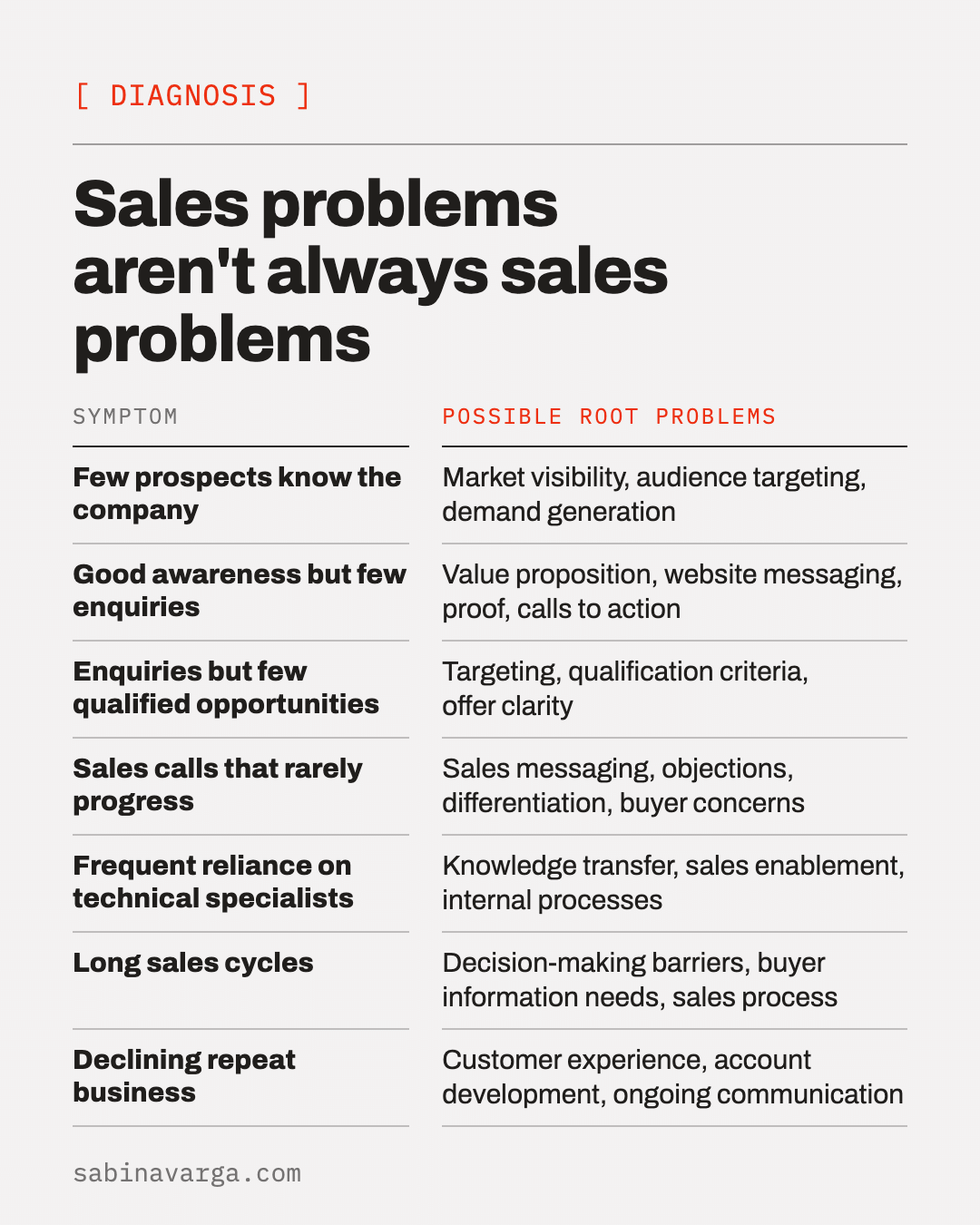
My aim as a B2B communication expert is NOT to call every problem a communication problem.
When I work with clients, I identify where communication genuinely limits performance and whether another investment would deliver more value.
Sometimes the right answer is another salesperson or a different pricing model, not more content or better messaging. And sometimes the business already has the expertise, people, and market opportunities it needs, but isn’t communicating effectively enough to turn them into sales.
Strategic communication as a nice-to-have
Communication is something a company invests in once the urgent business priorities have been addressed, right? It’s something to make the brand look better, but it’s not something the business needs.
Well, you don’t decide to start or end communication. Communication is already happening throughout the business, whether it’s strategically managed or not.
- when a salesperson explains the offer
- when a prospect researches the company
- when an engineer answers a technical question
- when a customer evaluates a proposal
- when a decision-maker recommends a supplier internally
So, there’s really no choice whether to communicate or not as a brand. It’s whether to leave all these activities disconnected, improvised, and inefficient, or create the conditions for them to support each other.
That’s why I see communication as part of commercial performance, not a separate nice-to-have investment.
Hi, if we haven’t met yet, I’m Sabina Varga. I’ve spent the better part of my career working with B2B tech companies, first as a content marketer and increasingly as a strategic communication consultant.
I work with B2B brands and leaders to make them more trustworthy, credible, and sales-ready in the public eye. If you’d like to explore any of this in your own business, send me a message.
Leave a Reply