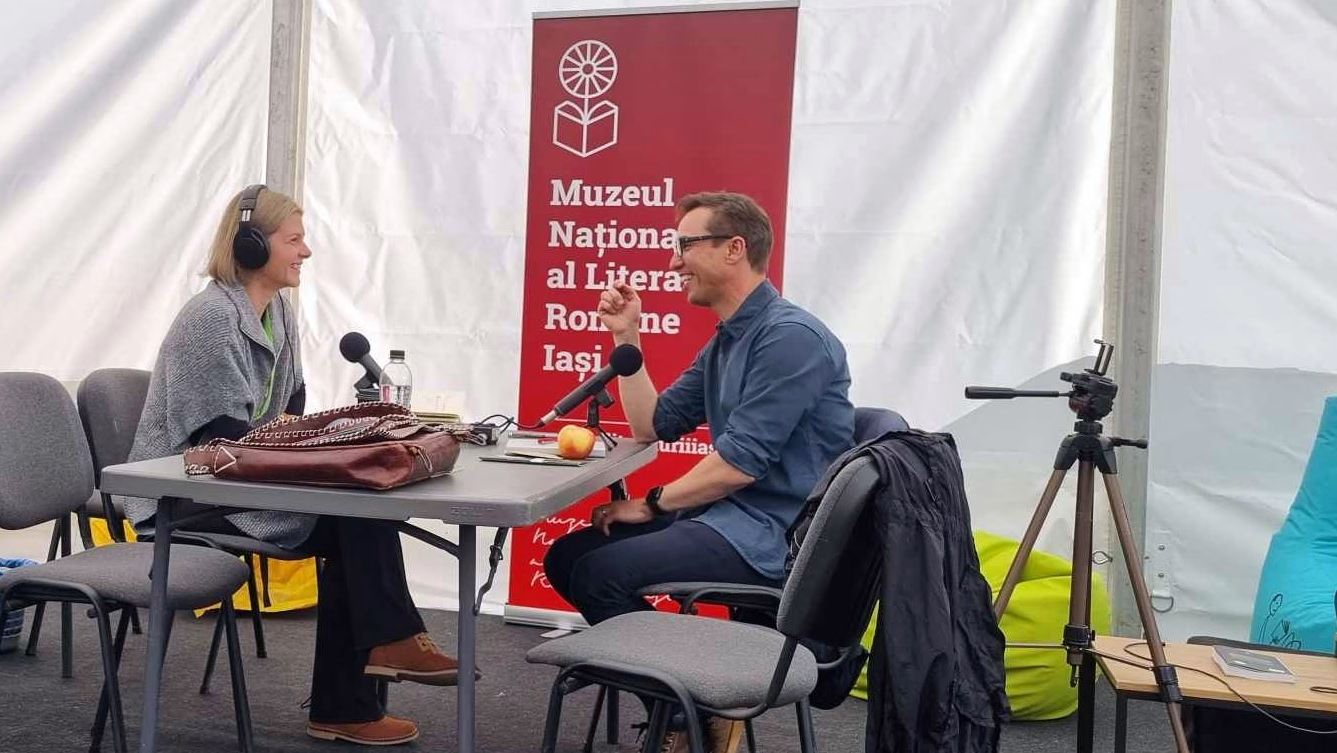
When Markus Zusak joined the Zest Podcast at FILIT Iași, he voiced an idea that many aspiring writers secretly carry: no one is going to read this.
While writing The Book Thief, he believed it would be his least successful book. As he put it during our conversation, how could anyone enthusiastically recommend a novel that is “set in Nazi Germany, narrated by Death, nearly everybody dies, and it’s 580 pages long”?
That expectation — or lack of it — became liberating.
Because he thought the book would fail commercially, he felt free to write it exactly as he wanted.
And isn’t it ironic? The book he assumed would be least read went on to spend over a decade on The New York Times Best Sellers list.
Let go of success
On the podcast, Markus described how easy it is to sabotage a project by overthinking its success. “If you overcomplicate thinking about how something’s going to be successful, [that] is the easiest way to make it not successful,” he said.
While writing, he watched other new authors around him get published. The temptation to compare was real. But he deliberately narrowed his focus: do what you have to do. Stay in your lane. If no one reads it, that has to be acceptable.
He also made a striking point about entitlement: “As soon as you start feeling like you’re owed something, you never get it.”
He described his early career as the slow climb of a roller coaster. The first four books were the steady ascent. The Book Thief was the drop — the moment when everything accelerated. But that drop was only possible because the climb had built stamina first.
Follow the surprise
Originally, The Book Thief was meant to be small. But as he wrote, it kept growing.
On the show, he offered what might be one of his most practical pieces of advice: “Follow your surprises… as soon as you feel something is becoming unusual, follow that.”
For him, the surprise was stylistic. The voice of Death opened up a world that felt fresh and alive — “like waking up and opening your door and the air is very crisp and a little bit cold.” Even when he felt tired, there were moments of wonder that kept the work moving.
“The best part of being a writer is when you surprise yourself,” he told me. If the writer feels that spark, chances are the reader will too.
Style: Simple words, reinvented
When asked how he developed his style, Markus spoke about abandoning the desire to sound intellectual.
After writing several books and experimenting with poetry, he realised something essential: creativity does not depend on complexity. “You can be very creative out of simple words,” he said.
Two ordinary words placed together in an unexpected way can carry more power than one “big” word. He pointed to children as natural masters of this. They combine words with freshness and surprise, which is something adults gradually lose.
He shared stories about his own children’s phrases, moments of linguistic brilliance that only a child could produce — lines that made him laugh and, sometimes, even made it into his work.
What he seeks in writing is that same sensation: the world we know, seen for the first time again.
Finding (and trusting) the voice
The voice of Death defined The Book Thief. On the podcast, Markus admitted that once that voice emerged, it gave him extraordinary freedom. He felt he could “take the book anywhere” because of it.
But voice is not always cooperative.
After The Book Thief, he spent years working on Bridge of Clay. He tried at least twelve different narrators before landing on the right one — and even that narrator had to be rewritten multiple times.
His advice was this: If the voice comes naturally, go. Don’t interrogate it. If it doesn’t, the struggle will be long. Voice, in his experience, is both mystery and foundation.
First drafts: Show up, even if it’s bad
During our discussion about first drafts — a topic I explored often in the Zest writing community & beyond — Markus admitted he has always written under pressure. Even in draft form, he aims for the finished product.
But he was equally clear: the hardest part is starting.
His solution is this: “All you have to do is just show up at the desk… just start,” he said. “Try not to make it good. Do something. After ten minutes, it usually becomes easier.”
He described early drafts as a kind of carcass — something imperfect that you can later pick apart and reshape. The point is not to produce brilliance immediately. The point is to create material.
And perhaps most importantly: don’t beat yourself up. If you’re truly a writer, you’ll come back the next day. Convincing yourself to return is half the job, he said.
Writer’s block as a lack of faith
“I can always write something,” Markus said. “I just can’t always write something good.”
Writer’s block is rarely the absence of ideas. It’s the difficulty of writing them at the level they deserve. Doubt slows him down. He admitted he would write faster if he doubted himself less.
And yet that dissatisfaction is part of his craft. The writers he most admires are often the ones who doubt themselves the most — because that doubt forces precision.
Writing is demanding. It requires both resilience and scrutiny.
“If it were easy, everybody would do it,” he said — a mantra that resonates deeply with my own process.
Reading narrowly, not widely
Since the season focused on how reading shapes writing, I asked about his habits.
Contrary to common advice, Markus doesn’t believe you must read everything. He reads narrowly and repeatedly — returning to books he loves to “unlock the secrets” of their craft.
Repetition builds familiarity with commitment, voice, and structure. It sets a subconscious standard: this is what you must try to live up to.
He mentioned writers who shaped him, including S. E. Hinton and her novel Rumble Fish, Lars Saabye Christensen and The Half-Brother, and Tobias Wolff’s Old School.
Two billboard messages
At the end of the episode, I asked him to imagine having a billboard in Iași on which he could place any message he wanted.
The first option: Problems create imagination.
He explained that imagination often emerges from obstacles — from solving narrative problems, from finding a way to make Death vulnerable rather than cruel.
The alternative: Failure is not failure.
Drafts that don’t work are not defeats. They are steps. Just as children learning piano need wrong notes to reach the right ones, writers need flawed attempts to reach clarity.
What has stayed with me years after that conversation was this: write without entitlement, follow the surprise, don’t beat yourself up, trust the voice when it arrives, show up even when it’s bad, and see problems as the birthplace of imagination.
The rest, as he proved, may take care of itself.
Leave a Reply